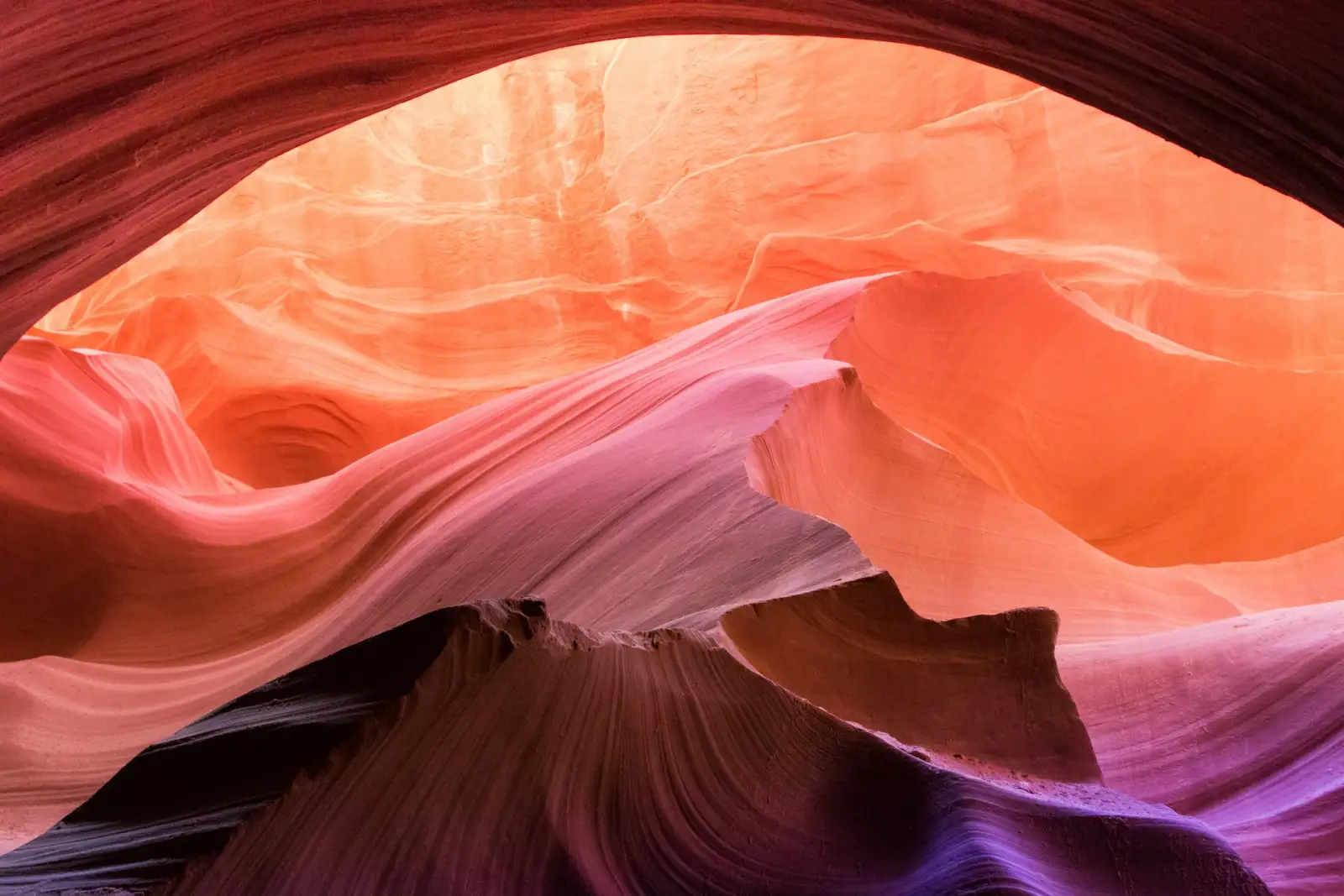
Upper vs Lower Antelope Canyon: Which Tour Is Better for You in 2026?
Short answer: choose Upper Antelope Canyon for easier walking and iconic light beams, or choose Lower Antelope Canyon for tighter rock formations, more active movement, and usually lower prices.
Short answer: choose Upper Antelope Canyon for easier walking and classic light beams, or choose Lower Antelope Canyon for tighter rock formations, more active movement, and usually lower prices.
If you’re planning a trip to Antelope Canyon, you’ll soon discover that it’s not just one canyon. When you search online, you’ll find names like Upper Antelope Canyon, Lower Antelope Canyon, Canyon X, and even Secret Antelope Canyon. All of them seem to carry the same “Antelope Canyon” label and all sound similar, and all promise the same surreal sandstone beauty. So what’s the difference? Are they connected, or completely separate places?
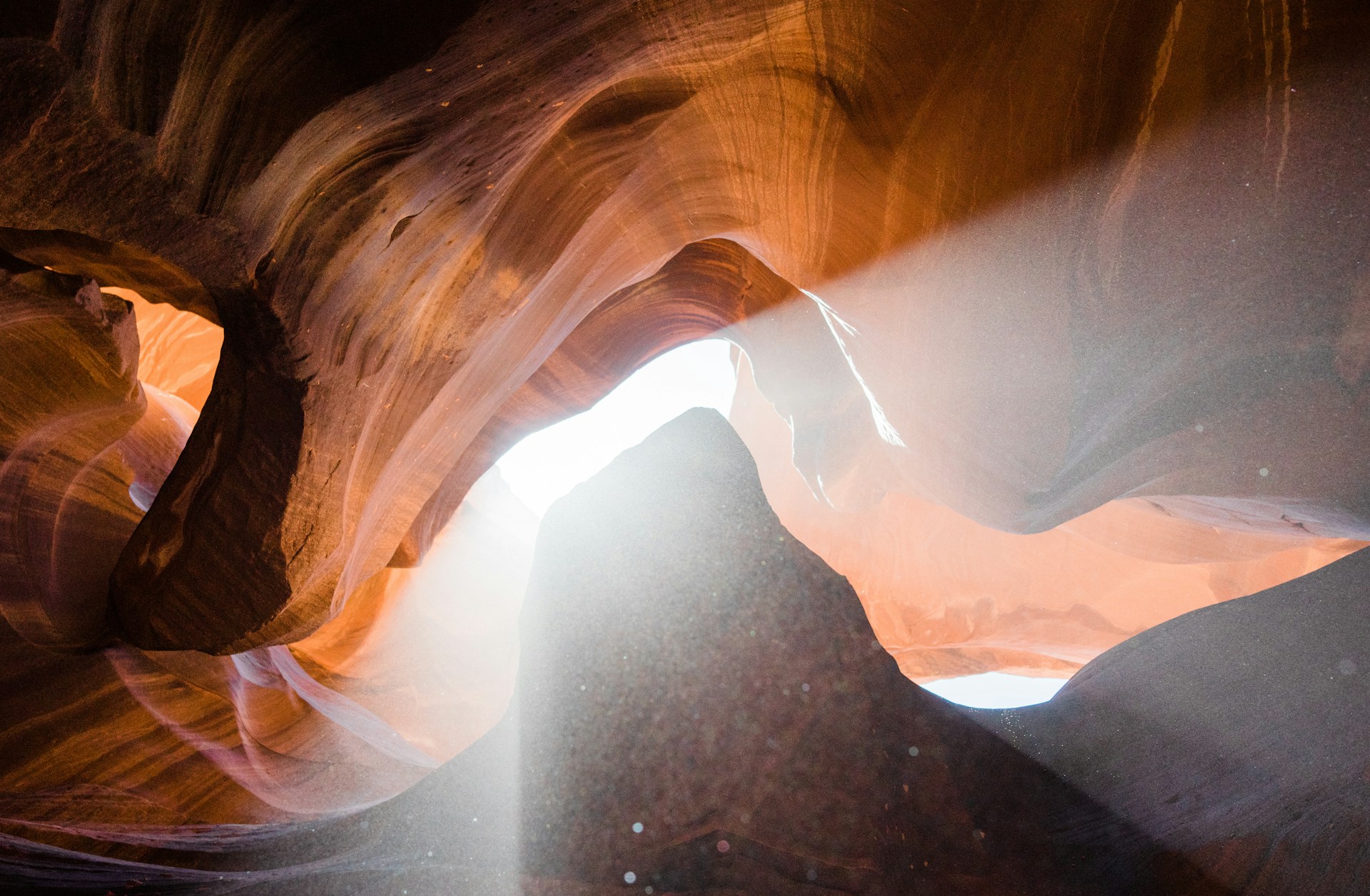
To answer that, let’s start from the beginning. Antelope Canyon is a slot canyon — a narrow gorge formed by water rushing through soft Navajo Sandstone over thousands of years. Flash floods carve smooth, flowing walls that twist and glow with reflected sunlight. These slot canyons are common across the desert Southwest, but Antelope Canyon stands out for its elegance and color.
If you’d like to dive deeper into the geology, rock type, and sandstone formation behind Antelope Canyon, check out this guide:
What Type of Rock Is Antelope Canyon Made Of?
In fact, all of these “Antelope Canyons” are parts of the same larger sandstone system — they share the same origin, geology, and breathtaking patterns of light and shadow. However, each section offers its own atmosphere and experience. The two most famous — Upper Antelope Canyon and Lower Antelope Canyon — are located just a few minutes apart, yet they feel surprisingly different.
So — if you just want to visit only one Antelope Canyon, which should you choose?
Before we answer that, it helps to compare the two famous canyons carefully so you know what you’re choosing between. Let’s first take a quick look at both canyons.
Upper Antelope Canyon
“The place where water runs through rock.”
— Tsé bighánílíní
Upper Antelope Canyon is the image most people picture when they think of Antelope Canyon: graceful, wave-like walls, wide openings above, and ethereal light beams cutting through the dust-filled air. In the Navajo language, it is called “Tsé bighánílíní” meaning “the place where water runs through rocks.” The name perfectly reflects the canyon’s essence — a reminder that these sculpted sandstone passages were shaped by the force of flash floods over countless years, with water, not wind, as the true artist.
Located on Navajo land just a few miles east of Page, Arizona, the Upper Canyon is easily accessible by guided tour. It stretches about 200 meters in length, with smooth sandstone walls rising up to 40 meters high. Its spacious corridors and open ceiling allow sunlight to pour in, creating the world-famous light beams that photographers dream of capturing. With its flat, sandy floor and easy walkways, Upper Antelope Canyon is ideal for families, casual travelers, and anyone who wants to experience its beauty without much physical effort.
Lower Antelope Canyon
Just a short drive away from the Upper Canyon lies Lower Antelope Canyon, known in the Navajo language as “Hazdistazí” meaning “spiral rock arches.” The name perfectly captures its character — twisting, turning corridors that spiral deep into the earth like ribbons of stone. While the Upper Canyon feels open and cathedral-like, the Lower Canyon offers a more mysterious and adventurous atmosphere.
Located just across the main road, the Lower Canyon is longer, narrower, and sits slightly below ground level. To enter, visitors descend a staircase into the winding sandstone passage, where sunlight filters down from above, bouncing off the curved walls and creating a rich spectrum of orange, red, and purple tones. The path includes short ladders and uneven steps, adding a touch of exploration. Because of its depth and complexity, the canyon often feels quieter and more intimate — a favorite for photographers and travelers seeking a more immersive experience.
Now that we’ve explored both canyons individually, it’s time to take a closer look at how they compare. Let’s start by examining their entrances, as this is where your experience begins and sets the tone for each.
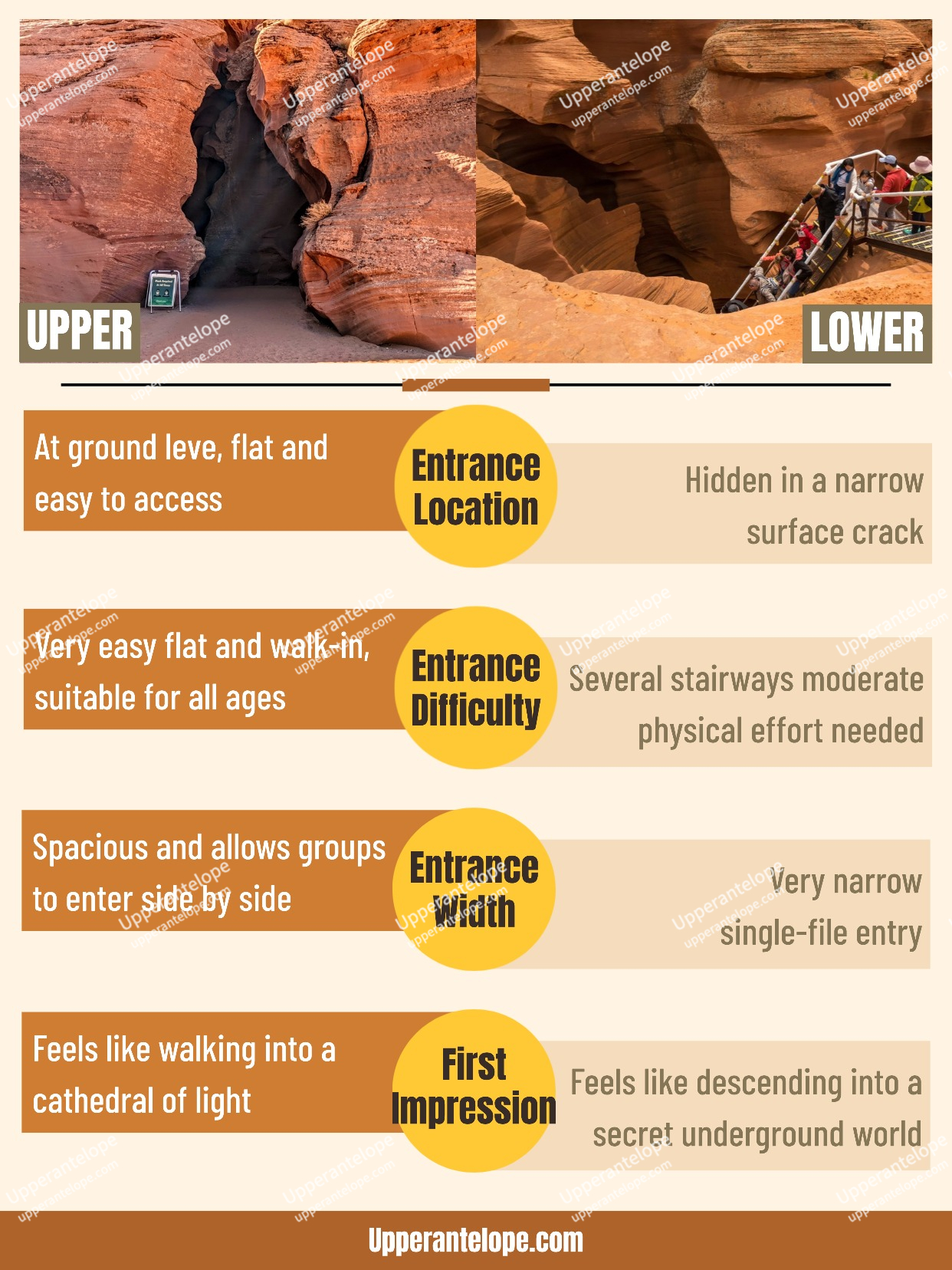
Upper Antelope Canyon features an entrance that’s at ground level, flat and easy to access. Its entrance difficulty is very low—flat and walk-in, making it suitable for all ages. The entrance is spacious, allowing groups to enter side by side. When you step in, it feels like walking into a cathedral of light.
In contrast, Lower Antelope Canyon’s entrance is hidden in a narrow surface crack. Several stairways mean moderate physical effort is needed to enter. The entrance is very narrow, requiring single-file entry. Your first impression will be like descending into a secret underground world.
Now, let’s delve into the interiors of both canyons to discover more distinct charms and wonders. The biggest distinction between Upper and Lower Antelope Canyon is their canyon shape, leading to thoroughly different touring experiences.
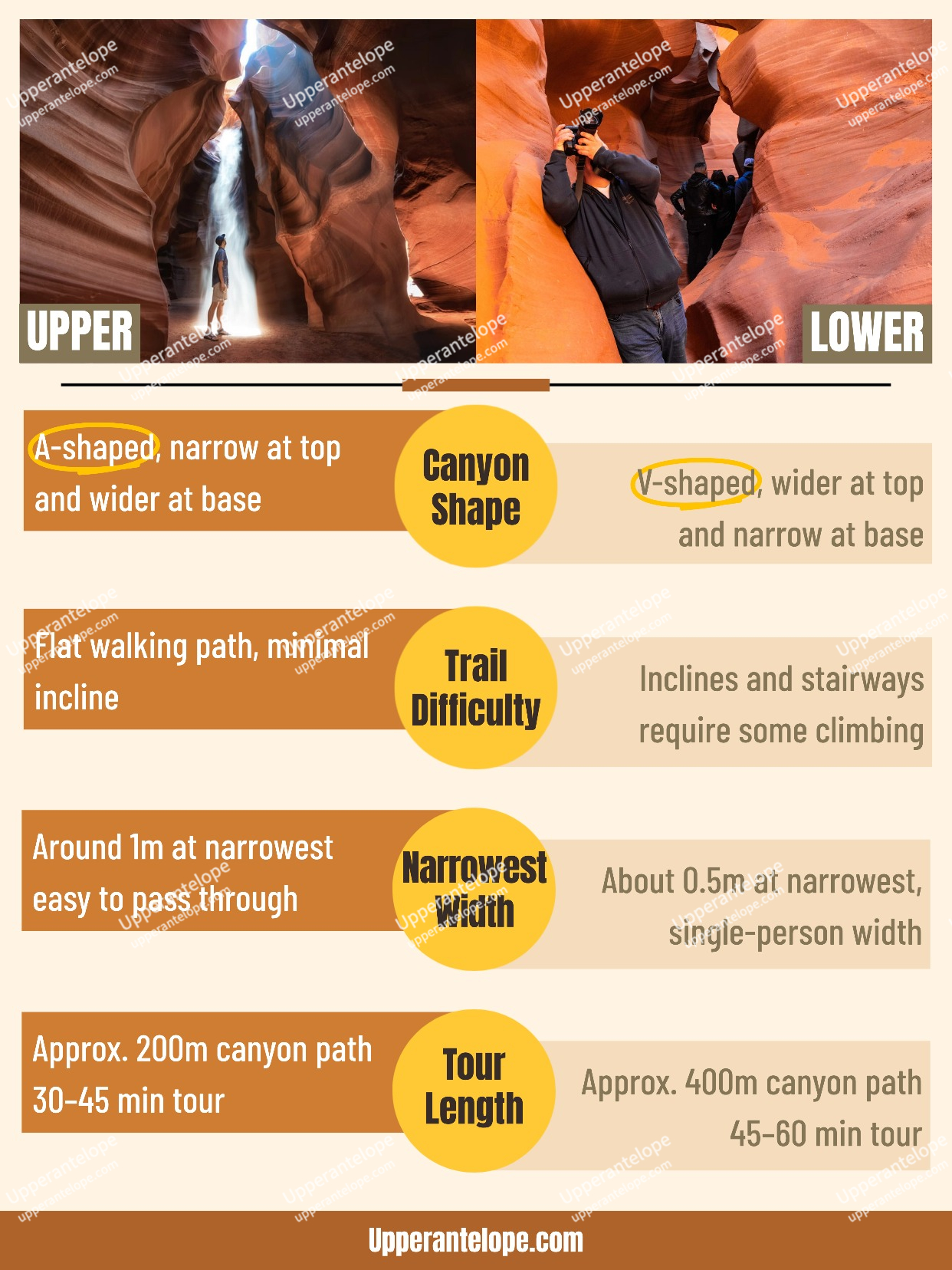
Upper Antelope Canyon has an A-shaped structure, narrow at the top and wider at the base. Its trail is flat with minimal incline, easy to navigate. The narrowest point is around 1m, allowing easy passage. The tour covers approximately 200m and lasts 30–45 minutes.
In contrast, Lower Antelope Canyon is V-shaped, wider at the top and narrow at the base. Its trail has inclines and stairways that require some climbing. At its narrowest, it’s about 0.5m, only wide enough for single-person entry. The tour path is around 400m and takes 45–60 minutes.
Now, let’s explore the lighting and visual characteristics that define each canyon’s aesthetic.

Upper Antelope Canyon is known for its strong direct sunlight that creates dramatic light beams. The best time to capture these is between 11:00 AM and 1:00 PM. Its color tone is warm reddish-orange, and ideal subjects include light beams, dust effects, and human silhouettes.
In contrast, Lower Antelope Canyon has soft, diffused light with subtle tonal layers. It’s best photographed in the morning or afternoon, when the soft light produces rich shadows. The color tone features gradual transitions from orange to purple, and ideal subjects are curves, rock textures, and color transitions.
Having compared the canyons themselves, let’s now focus on other practical aspects. To understand which one might be the better fit for your visit, let’s start by reviewing some of the most essential — yet often overlooked — details: tour operators, meeting points, arrival times, tour times, age restrictions, and tour duration.
These practical differences can shape your overall experience and are especially worth noting if you’re traveling with children, seniors, or anyone with limited mobility.
Both Upper and Lower Antelope Canyon are located within the Navajo Nation Reservation, a protected area managed by the Navajo Parks & Recreation Department.
Because these canyons are considered sacred sites and are part of the Navajo community’s cultural heritage, independent entry is not allowed. According to the official regulations, all visitors must be accompanied by a licensed Navajo guide.
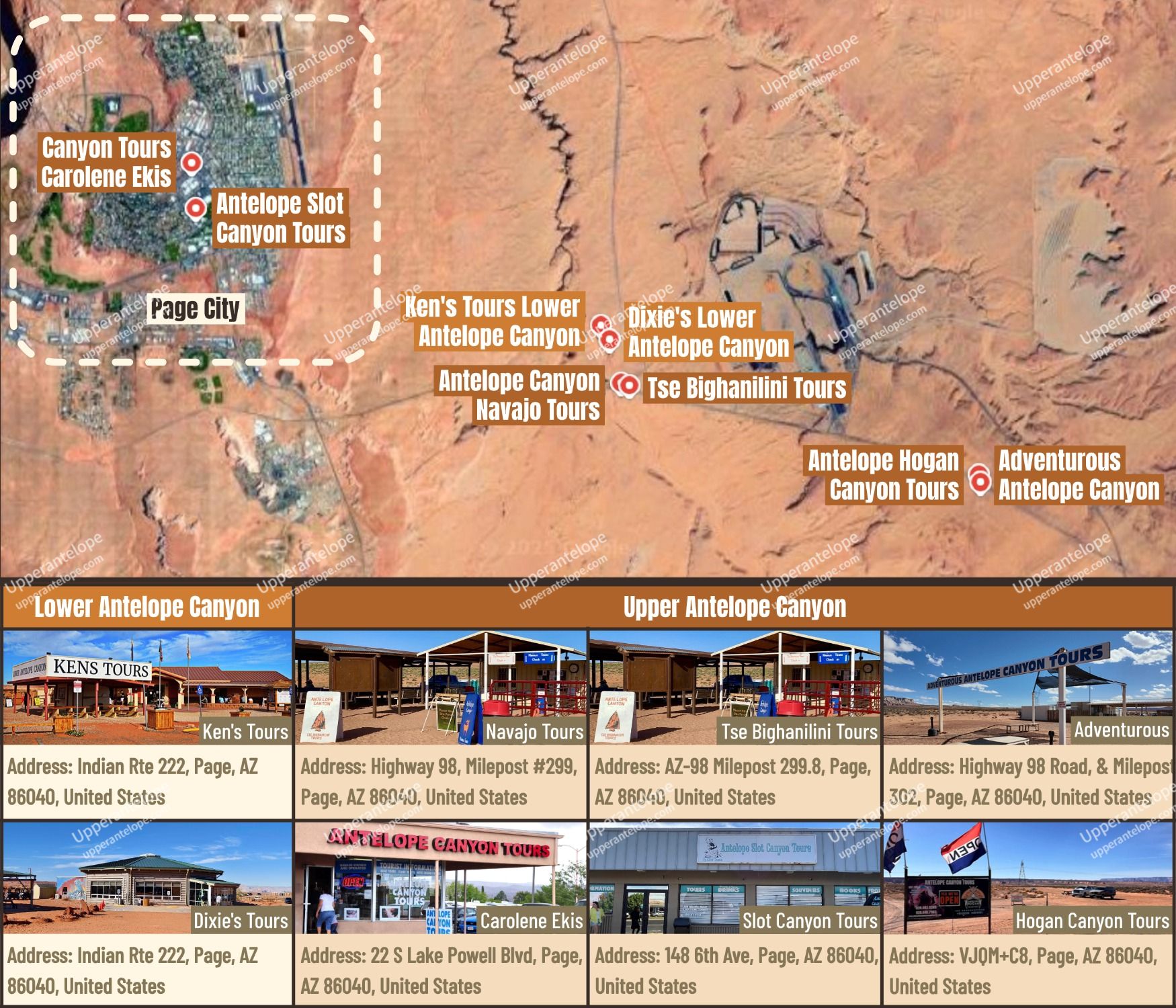
Each canyon is managed by a small number of authorized tour operators who work closely with the Navajo Nation to ensure safety, preservation, and visitor education. Currently, there are six licensed operators for Upper Antelope Canyon and two for Lower Antelope Canyon, each with their own meeting points and schedules. Please note: no matter where or how you buy your ticket (third-party reseller, hotel, or directly), your actual tour will be run by one of these licensed operators — so always check which operator is listed on your confirmation and verify the meeting point and arrival instructions before you travel.
Below is a list of the official tour companies and their meeting locations:
Upper Antelope Canyon authorized tour operators
- Antelope Canyon Navajo Tours
Meeting point: Highway 98, Milepost #299, Page, AZ 86040, United States - Tse Bighanilini Tours
Meeting point: AZ-98 Milepost 299.8, Page, AZ 86040, United States - Adventurous Antelope Canyon Photo Tours
Meeting point: Highway 98 Road, & Milepost 302, Page, AZ 86040, United States - Antelope Hogan Canyon Tours
Meeting point: VJQM+C8, Page, AZ 86040, United States - Antelope Canyon Tours by Carolene Ekis
Meeting point: 22 S Lake Powell Blvd, Page, AZ 86040, United States - Antelope Slot Canyon Tours
Meeting point: 148 6th Ave, Page, AZ 86040, United States
Lower Antelope Canyon authorized tour operators
- Ken’s Lower Antelope Canyon Tours
Meeting point: Indian Rte 222, Page, AZ 86040, United States - Dixie’s Lower Antelope Canyon Tours
Meeting point: Indian Rte 222, Page, AZ 86040, United States
Age Restrictions
Age policies vary noticeably among the seven licensed operators, and there is no single standard that applies across all tours. Some companies welcome infants and young children, while others set minimum ages—such as 6 or 8 years old—due to safety considerations or the physical nature of the route. A few operators apply the same rules and pricing to every visitor regardless of age. Because these guidelines differ from one operator to another, travelers are strongly encouraged to review the specific requirements before booking.
Ticket Prices
Most operators follow a straightforward pricing model in which adults and children pay the same rate. Only two companies offer a dedicated child price, while the remaining operators maintain a uniform fare for all age groups. This consistency reflects the overall structure of tourism regulations within Navajo Nation.
Tour Duration
While each company designs its own schedule, the time spent inside the canyon is broadly similar—typically 40 to 60 minutes. Access logistics, however, differ between the two canyons. Lower Antelope Canyon sits close to the meeting points, allowing guests to walk directly to the entrance. Upper Antelope Canyon requires transport in authorized 4×4 trucks, as private vehicles are not permitted on the route leading to the canyon.
Given the variations among operators, the chart below consolidates all key information—age policies, pricing, and duration—for quick and convenient reference.

Tour Time Slots
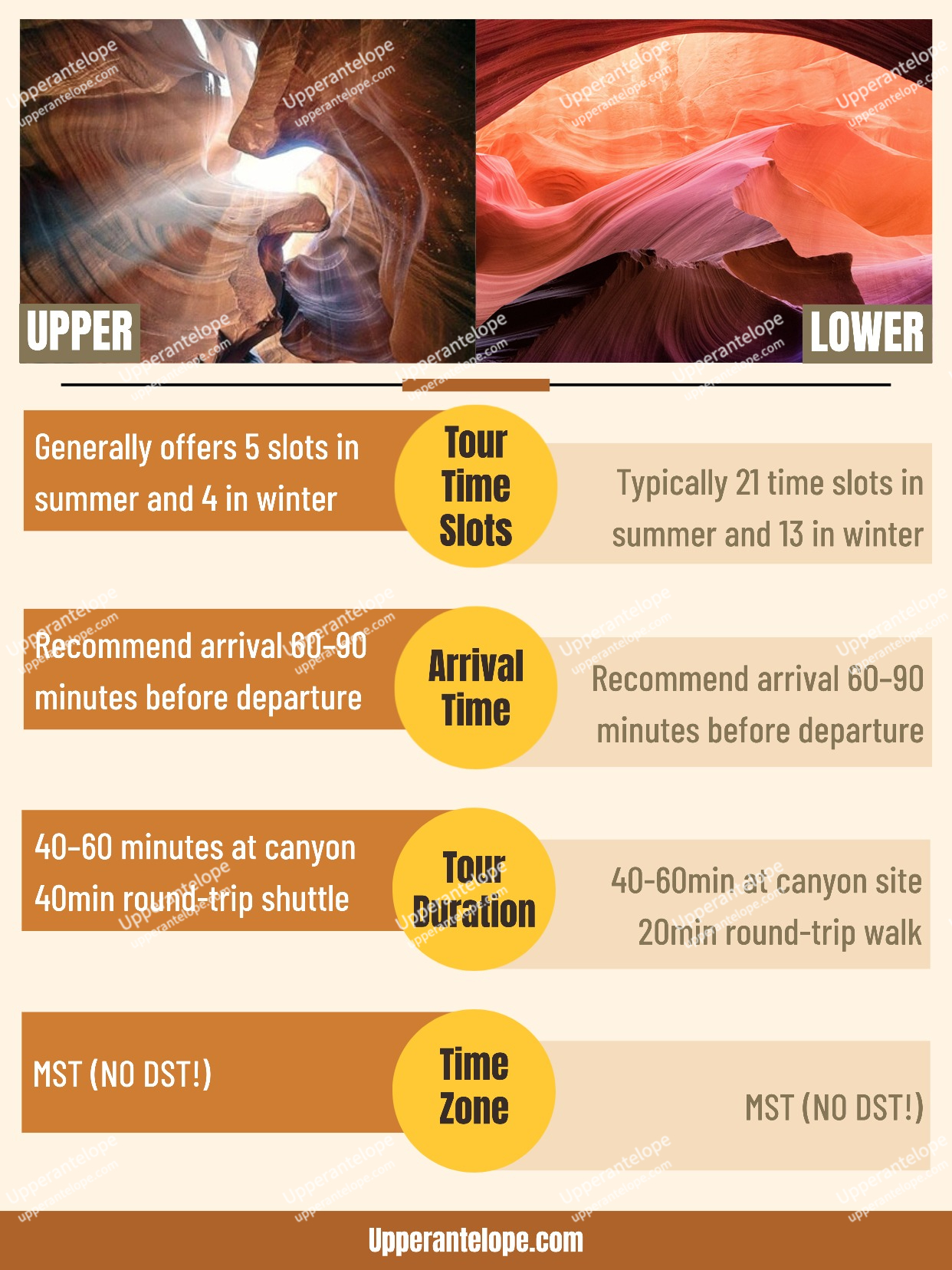
Both Upper and Lower Antelope Canyon operate on seasonal schedules, offering different time slots in summer and winter. Upper Antelope Canyon typically provides five daily departure times in summer and four in winter, while Lower Antelope Canyon operates on a much broader schedule—often 21 time slots in summer and 13 in winter. However, the exact times vary slightly between operators. This staggered scheduling is intentional, designed to distribute visitors throughout the day and prevent overcrowding inside the narrow sandstone passages.
Arrival Time (Check-in Time)
Most licensed operators require guests to arrive 30–45 minutes before the scheduled tour departure. This check-in window ensures enough time for registration, group organization, and transportation when required. However, if this is your first visit to the area, it’s wise to arrive at least 1–1.5 hours early. Traffic delays, wrong turns, locating the correct meeting point, or long lines during peak season can all impact your timing. In short, avoid arriving at the last minute — don’t cut it close.
Time Zone
All Antelope Canyons are in Arizona, which uses Mountain Standard Time (MST) year-round. But Arizona does NOT observe Daylight Saving Time.
This means:
- From March to November: Arizona time = same as Pacific Time (PDT) 1 hour behind most of the Mountain Time Zone (e.g. Denver)
- From November to March: Arizona time = same as Mountain Time (MST)
For a clearer reference, you can check Antelope Canyon’s current local time:
Antelope Canyon Time Zone
Let’s summarize the comparison in a table.
By now, you probably have your own choice in mind.
If you want iconic photos, easy access, and the famous light beams — choose Upper Antelope Canyon.
Check here to purchase Upper Antelope Canyon Tickets
If you prefer adventure, fewer crowds, and more flexibility for photography — choose Lower Antelope Canyon.
Check here to purchase Lower Antelope Canyon Tickets
Still can’t decide? Then visit both! Many travelers book one in the morning and the other in the afternoon. Experiencing both gives you a complete picture of how wind, water, and time have shaped this sandstone masterpiece.
Final Thoughts
Whether you choose Upper, Lower, or both, Antelope Canyon will leave you speechless. The colors, curves, and silence of the canyon are nature’s way of reminding us how powerful—and beautiful—time can be.